So you want to research Palestine?
So, you want to research something about Palestine as a mental health professional?
Research interest in Palestine has ballooned in recent years. Certainly, the ongoing genocide contributed to this trend. This piece is a celebration of this zeal, but also a cautionary warning for those in academia. It is auxiliary to the recent original research report we just published, The Violence of Liberal Racism: What Palestine Reveals About British Mental Health Care.
In this piece, we will discuss what it means to be an anti-Zionist academic and mental health practitioner, interested in something related to Palestine or the genocide, situated in the Global North (as in, not in Palestine). There are things that Palestine reveals of our liberal institutions, with implications beyond Palestine proper. But if you stop reading now, then leave with this:
Censorship around Palestine contributes to its erasure.
How ought a researcher or an academic in mental health navigate the immense censorship around Palestine? This piece serves as a reminder of the cost of playing into epistemic erasure.
Zionist Racial Formations in Mental Health
To begin, it is important for us to take stock of our political moment. What does it mean to think of research-as-resistance in liberal institutions like universities today? Racial formations—stemming from but not limited to nationalism, security, border policing, Zionism, etc.—are deeply embedded in academic structures. Indeed, the academy is an essential vehicle for domestic statecraft and imperialist interests abroad.
The fields of mental health are shrouded in cloaks of benevolence and openness. Professionals often believe the aim must be to improve everyone’s mental health, regardless of culture, creed or politics. In turn, they claim mental health must remain apolitical for this reason. Yet such generic aspirations serve only to deflect from mainstream psychology’s understated political philosophies. Everything is political—including mainstream mental health. Denying this only serves to reify the dehumanising forces of imperialism and Zionism in our fields.
You may encounter fellow researchers in mental health, passionate about a subject they deem rather apolitical (e.g. depression, neuroscience, etc—they are not apolitical). You assume you may speak just as passionately about Palestine. This would be a mistake; like a mirage, the liberal illusion disappears as soon as you approach it. Palestine, as the report discusses, is deemed “too political,” even among allegedly anti-racist mental health professionals, and despite growing institutional commitments to anti-racism, Black Lives Matter, LGBTQ+, etc. The label of “political” does quite a lot of work here. Other students are not pushing the boundaries of liberal acceptability—you are. And when you are outside these boundaries, you may start feeling threatened. Allegations of anti-semitism. Charges of radicalisation.
As the report explains, the legitimacy afforded to counter-terrorism and Zionism in mental health means Palestine is primarily read through existing securitising and racist logics. Counter-terrorism logics racialise Muslims as threatening. Zionism racialises Jews as a monolith and vulnerable to assertions against Israel. Racialised Muslim researchers thus face a double-penalty: radicalisation for expressing political views outside of British interests, and anti-semitism for offending Jewish vulnerability. White people are also impacted for speaking up on Palestine, but only insofar as they are accused of antisemitism in the Zionist racialisation of Jews. In other words, white people are privileged from being framed as security threats through counter-terrorism—this is coded to Muslims in public consciousness.
And the erasure of Palestine in mental health is glaring. Despite some very prominent voices, the colonial occupation of Palestine is routinely erased. This is not as well documented as it should be. The Lancet, one of the world’s most prestigious healthcare journals, has long sided with Israel’s narratives. Studies indicate how liberal Zionist narratives predominate in the field, continuously erasing the history of ethnic cleansing, displacement and occupation. We are instead fed a barrage of group identity and radicalisation theories to explain the “Israel/Palestine conflict”—a key, liberal Zionist talking point. Israel is deeply embedded in Western mental health fields, as the prominent Israeli psychologist Dan Bar-On noted. He observed Israeli psychology is the least likely to find anti-Zionists, not least because of its proximity to the military.
There are other, understated elements which make Palestine work difficult. As stated above, the university does not exist in a political vacuum. It is beholden to a web of interests and stakeholders which manage, among other things: the university’s public image, government security policies, funders (who may be Zionist) and insurance (which also then informs research ethics procedures). All of these contribute to the academic erasure of Palestine, albeit in more banal, administrative ways.
In summary, academia is not an ideal site of resistance. It’s simply a refraction of the violence you see on your screens.
Normalise to Survive
With everything said, you’re still interested in researching something around Palestine. You recognise the threat—you feel how uncomfortable it is. Now you are faced with two choices: normalise the security and Zionist narratives somewhat to survive and mitigate the “risks” of doing this work. Or disrupt these narratives to resist their legitimacy. Let’s start with normalisation.
You feel you are pushing the boundaries. You’re anxious. Your friends, colleagues and supervisors are, too. “Don’t rock the boat too much,” it is often said. You really want to do this work, so perhaps a few compensations are in order. There are several liberal strategies to make your Palestine research more palatable. The following is a non-comprehensive list:
1. Speak of the “Israel-Palestine conflict.”
2. Condemn Palestinian resistance.
3. Reproduce the discourse and narratives around terrorism.
4. Avoid mentioning Zionism, ethnic cleansing, and settler-colonial history, thereby contributing to the epistemic erasure of Palestine.
5. Dismiss Zionism’s acceptability in the fields of mental health.
6. Speak of racism as a dynamic of group identities, rather than a process of racialisation.
7. Dismiss the significance of counterterrorism in racialising Muslims as especially prone to radicalisation.
8. Dismiss the significance of the Zionist project’s objective to racialise Jews in the orbit of Israel, thereby also dismissing the significance of anti-Zionist Jewish movements.
9. Dismiss US/UK/European repression for Palestinian solidarity, today and historically.
10. Overall maintain the legitimacy of the Zionist project in other words (the Oslo peace process, etc).
There are certainly more. Many such strategies can be readily found searching for Palestine in academic journals. But these strategies, employed willingly or not, are harmful. In doing any of the above, the researcher inadvertently feeds a discourse which legitimises the Zionist project, contributing to epistemic erasure.
And sometimes, such strategies are employed deliberately—not out of ignorance. People know they’re wrong; they believe the ends justify the means. If we publish research on Palestine, while playing somewhat into racist, securitising and colonial logics, it still counts, doesn’t it? You may not have pushed back against all forms of erasure, but you got “Palestine” out there and you’ve protected yourself from accusations of anti-semitism and extremism. That’s the strategy.
Unfortunately, the line between strategy and cowardice can be thin. We don’t speak of cowardice or courage enough in research. Perhaps, in the end, it’s not only epistemic erasure that is of consequence. Without interrogating our fears, and in fact giving in to them, we affirm the substance of this fear for all, including future generations.
Why are we doing this work? Is it because we feel guilty? What would it mean for us to be driven by a spirit of resistance, not guilt. There are many ways of supporting the Palestinian cause—just look at direct actionists on arms factories. In this age of intense repression, we must learn from others like the activists as to how we proceed. Sacrifice is a keyword. To do this work earnestly, we must resist the temptation of engaging in the liberal acrobatics.
Disrupt to Resist
Maybe, despite the threat, you are still committed to liberatory work. You’re not anxious or—better yet—you’re anxious but feeling courageous. Fear and anxiety are healthy responses to threat. It means you’re fully aware of the risks: the backlash and hounding within your field (Ghassan Abu Sita); expelled and prevented from completing your studies (Haya Adam); or hounded out of academia by Zionist groups (Anna Younes). We must all strive to make courage more intentional. That is what resistance is all about.
And resistance today requires disruption, which occurs as soon as you eschew with the liberal narratives of the previous section. This involves, foremost, surfacing that Zionism is a racist, settler-colonial project founded on the demographic ethno-supremacy of a settler community. All our work must surface this undeniable fact: Zionism is racism. The abolition of all racist ideologies, including Zionism and imperialism, should be a central tenet in all fields of health. This is the central thrust of our work today, not for the sake of our careers, but for the sake of our collective liberation.
Two more thoughts on disruption:
First, we are not at the service of our professions. Why should it matter if psychology changes as a field, if it becomes more anti-racist or not? What matters, for any truly anti-racist commitment, is if we’re at the service of the people or not. At times, these two commitments—the field and the people—overlap. But as a rule, they do not. If the river of commitments is always flowing towards us demonstrating our “contribution to the field”, we must learn to swim against it.
Second, view Palestine as a window into existing problems. Racism, imperialism, colonialism. It is paper-thin to discuss the erasure of Palestinian solidarity in mental health, without surfacing how this is legitimised within wider racist and Islamophobic structures. I encourage researchers to consider that Palestine is erased here, not there. Our emphasis should be on our collective repression. So long as we cannot theorise and understand how Zionism is an extension of white supremacy here, we can never truly support Palestinians there. And, in this case, Zionism is a valuable window into imperialism and white supremacy.
Academic research is not the ideal site of resistance. Researchers must ask themselves, “How exactly do I make a difference?” The truth of this may not involve the research directly, but how we contribute to the movement of resistance to racism, fascism, and imperialism. This is most likely not going to happen within universities. I encourage all new researchers to develop their ties with the movements first and foremost. For what it’s worth, your ability to stand outside a police station, awaiting the release of protestors who have been detained for their Palestinian solidarity, may matter more for the sake of community building than any piece of writing ever could.
Conclusion
This piece was not to avert people of this work. But it is important for all researchers to ground themselves in the soil of the reality that we are confronting. It serves no one—not least myself, certainly not Palestinians—to paint a flowery reality of critical research. If you choose to do this work, however, renew your intentions in terms of the sacrifices and challenges you will face.
Related

Understanding Welfare State Violence
Calling some people a ‘burden’ provides a cover story for welfare state violence.
An Introduction to Politicised Somatics
We are portals towards liberation.
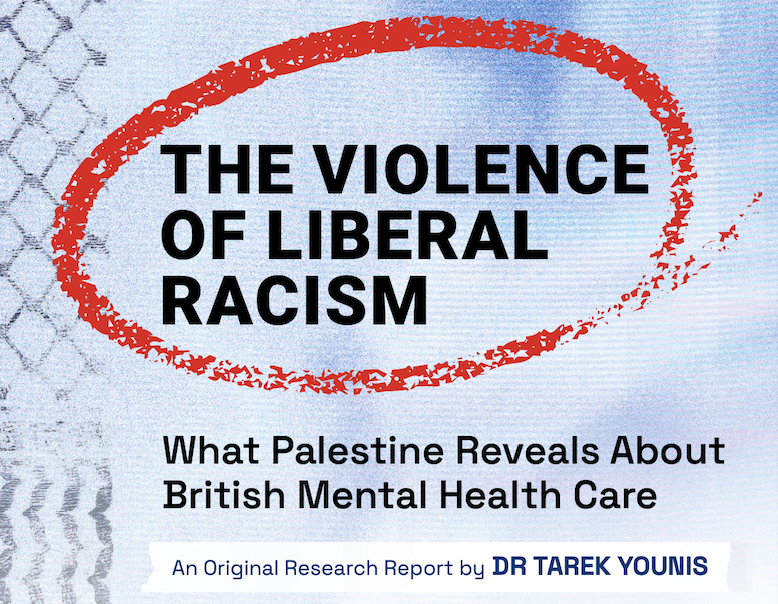
The Violence of Liberal Racism: What Palestine Reveals About British Mental Health Care
Inside Movement Medicine: Meet Macole
“I’m learning how it also starts from the self and how it is at the cellular level in which we create ripples and changes at a more macro scale. Innerstanding that being in the body, as a site of transformation, simultaneous effects broader structures. So much of the time we are understanding oppression by intellectualising it.”
Building Brave and Beautiful Movements
Exploring the conditions and contexts that shape how we build and organise within social movements. We are ready.
Politicised Somatics in Practice, Liberation, and Contradiction
Movement medicine practitioner-in-training dr dima mekdad explores how somatic practice illuminated and complicated her embodied experience navigating the liberation of Syria.
Life-Affirming Research at HJL
Exploring the role of research in building life-affirming, participatory, and collaborative visions of community-led health.
Community Accountability, Research and Ethics (CARE)
Together we imagine what research ethics could look like if it was accountable to communities and movements and practise ethical research differently