Movement Medicine
Radical social change is only as effective as it is made sustainable. Operating amidst state violence, austerity, rising fascism, imperialism, climate catastrophe and more has left us under-resourced and in constant cycles of burnout, conflict, and under-interrogated change. Trapped in these cycles, our communities, movements, and grassroots solutions don’t have the space to grow and thrive. This pattern prevents us from building shared strategy, having lasting wins that we can build on and from. Without sustainable, politically-literate support systems to enable embodied leadership, collective alignment, and action, we risk staying stuck in these patterns.
Our Movement Medicine programme looks to grow the capacities, skills and resources of grassroots movements, community health providers and those at the frontlines to become sustainable and adaptive in contexts of oppression that rely on our un-survivability. Through this work, we aim to bring about conditions for meaningful movement making and liberation.
We work with movement leaders and health and healing practitioners to:
- Explore the embodied skills, relationships and ways of being that support healing justice – building and extending trust, holding contradictions and complexity, visions for the future, holding the short and long term, consent, discernment and boundaries, and more.
- Develop a shared radical vision, analysis, and understanding to navigate our current conditions and politics, and to build together toward our vision.
- Explore and interrupt some of the trauma based reactions within movement culture- shift, from splitting to interdependence, from pulling each other down to building each other up, from criticising risk taking to celebrating experiments, and more.
- Understand how trauma healing serves movement building, sustained relationships and strategic experiments.
- Learn about conflict as generative – discerning our triggers, deepening trust and learning across conflict
- Explore and converge on what we are transforming toward.
Learnings & Methodology
In 2022, we held our first Movement Medicine retreat, taking 27 movement leaders from different fields and generations from the UK on a 4-day retreat led by Staci K. Haines where they explored embodied social change. In 2023, we brought together another 30 organisation leaders, community workers, health care practitioners, and organisers. These retreats were designed to explore the interdependence of personal and systemic transformation, the relevance of a trauma and healing analysis, and to explore the visions and capacities we need to movement build in these times.
Later in 2023, the Movement Medicine Practice Labs emerged as ongoing rehearsals of honest and open collaboration, hacking and exploring what it means to resource one another with experience, ideas and methodologies for organisational and movement infrastructure building.
The key learnings from testing these methodologies and piloting different pathways for bringing them into our communities have informed the shaping of the current programme. Some of our reflections include:
- The prevailing narrative that frames traumatised individuals, living under brutal, exploitative and harmful systems, as “unwell” is not only a flawed perspective but also reinforces an individualised medical model of healing – one that places the responsibility for harm or healing from it on the individual rather than the system.
- Understanding that individual expressions of trauma are partly collective and systemic in origin, helps us recognise that our responsibility towards healing is something that must also be collectively and relationally held.
- Historical and persistent harms remain part of us and therefore part of our movement work. It impacts our capacity to be open, creative, to grow and transform. It ripples out across our communities, getting amplified and becoming encoded into our systems. We may experience this as “stuckness”, burnout, conflict or other harmful ways of being.
- Creating spaces where we can connect with our embodied ways of being and consider how those responses also flow through our interpersonal relationships and manifest at larger scales in our organising, communities and movements is desperately needed if we are to move towards transformation. As adrienne maree brown says “What we practice at a small scale sets the patterns for the whole system”.
- Doing this together and drawing relationships can allow us to honour and welcome cultural, ancestral and spiritual traditions that support and resource us.
Based on these learnings, politicised somatics as a means to connect personal and systemic transformation has become key to our work. It provides people, groups and movements with effective ways to work with trauma and develop embodied skills for leadership, organising, and working together for social change. Embodied healing from trauma and oppression frees up our creativity, helps us hold complexity, and supports us in building relationships that can navigate disagreement, joy, learning, and change.

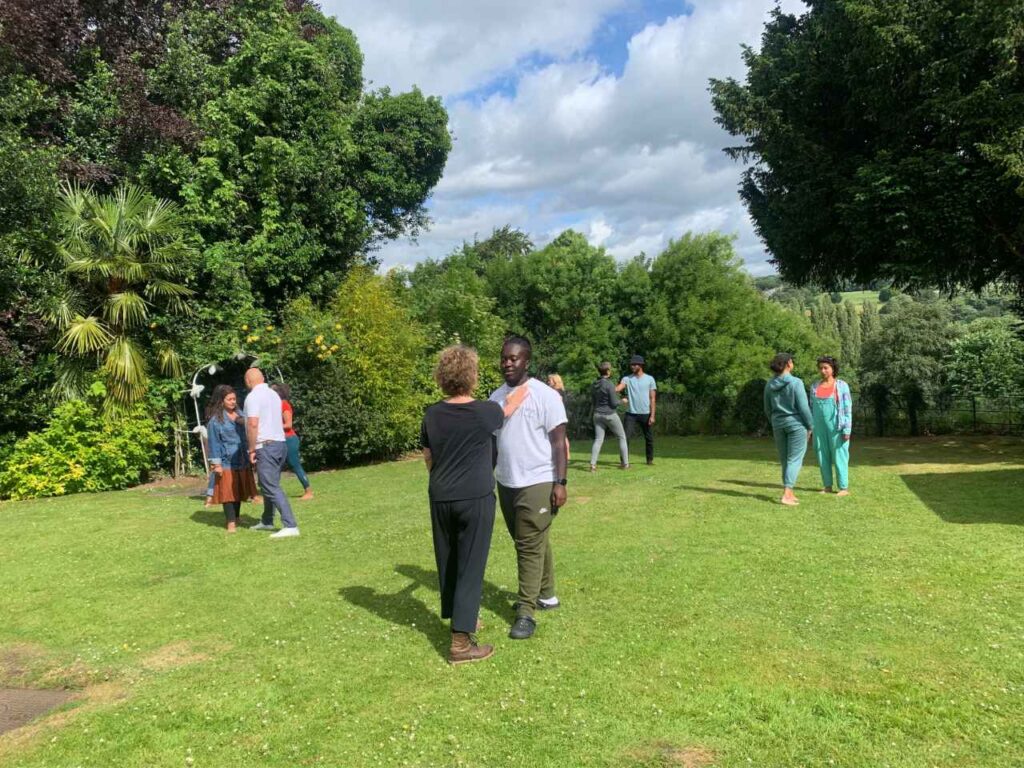
Somatic Education
In early 2024, we started developing a year-long programme and curricula to deepen training for more than 20 facilitators (who had previously been on the introductory course). This cohort will go on to deliver somatic education within their own communities and movements and support ongoing embodied practice.
Embodied leadership is a practice of healing justice. It asks us to align our actions with our values and to practise in alignment with our shared vision. The 2024 cohort will connect leadership development and personal healing to contribute to transformative work on various planes. They will develop shared understanding for how trauma, violence, and oppression shape our organising and movements. They will access and develop embodied skills to strengthen their leadership and capacity to vision, recognise shared conditions and sites of shaping, and use that information to shape strategies and tactics.
This programme is part of our strategy to create a pool of UK somatics practitioners and UK-specific curriculum. The 2024 cohort will connect leadership development and personal healing. They will develop a shared understanding for how trauma, violence, and oppression shape our organising and movements. They will access and develop embodied skills to strengthen their leadership and capacity to vision, recognise shared conditions and sites of shaping, and use that information to shape strategies and tactics.
We understand movements in their fullest expressions to include participation from grassroots organisers and informal community groups to frontline service providers and formal community-interest or charitable organisations. In offering a container for this work, we are supporting long-term relational infrastructure. Embedding politicised somatics within abolitionist movements for social and climate justice will enable us to move and mobilise together long-term, and under pressure, towards collective liberation.
Practitioner Cohort
Somatic training is often financially and geographically inaccessible to those best placed to use it. This cohort’s demographics reflect our commitment to Global Majority leadership, proximate leadership and disability justice. The community first responders in particular will be people already embedded in community.
This programming is free for all participants as we are committed to making lasting investments in transformative health and healing infrastructure for our communities. It also requires a long-term engagement from the cohort to spread somatics in a way that is aligned with our values and ensures quality and safety around what is delivered as politicised somatics.
By choosing to participate in the training, participants make an initial commitment of one year, followed by a longer-term commitment to the work. They study between training and are part of our broader strategy of bringing somatics to movement work. They participate in ongoing assessments, risk-taking, and growth in somatic methodology, practices and processes, as well as engaging in their own somatic healing.
The Movement Medicine Practitioner Training programme is the beginning stage on a 3-5-10 year development path. It is a programme designed to build a collective and coordinated body of practised, experienced, committed teachers and facilitators who can competently move politicised somatics forward through courses, organisational and group interventions, and collective practice with social justice movement partners. It is not a training-for-trainers. We do not teach somatics to consultants who then take it out into their individual work. Instead, it is designed to build a powerful, effectively coordinated collective body of diverse somatics teachers who work together to serve movement building that is more effective, inclusive, and strategic toward systemic change.
We believe that embedding a culture of embodied leadership in our movements will facilitate necessary personal, community, and collective transformation – enabling us to interrupt and intervene in harm and move together towards our shared liberation goals. When we dig into the interdependence of personal and structural change, build collective embodied habits both within and outside of survival, and align our actions with strategic vision we create shared capacity for transformation. This is the work of healing justice.
Practices
Our Movement Medicine work draws upon the lineages of many and acknowledges that so many of our ancestral, cultural and spiritual practices also encompass somatics.
One of our teachers, Staci K Haines, describes somatics as “a mind/body methodology that supports deep personal change, trauma healing, and embodying new practices for individuals and groups. The aim is to align our skills and capacities, ways of being and relating, and actions with our values and visions, even under pressure. For Somatics this is the test: how do we think, act and relate from what we most care about, including in the most challenging of circumstances, rather than reacting from what is familiar and accepted?”
Practically, embodiment means that people (and groups) are able to adapt to, and are shaped by, their personal and community experiences and conditions. These adaptations develop both resiliency and survival strategies that drive our actions, beliefs, emotions, and how we relate – which may or may not be aligned with our values and vision. And these adaptations can become embodied, meaning that they become embedded in our deep neural pathways, nervous system, and muscles. They become part of our psychological and social identity. A somatics approach works holistically through the body, thinking, emotions, relations, and commitments to access and transform survival reactions, orientations, and experiences while building and embodying new choices and competencies.
When people are more resourced, relaxed and resilient they have an increased capacity for human connection and creative problem-solving. They are to sustainably work towards positive change for themselves, their communities and across movements.
Resources
Related

Understanding Welfare State Violence
Calling some people a ‘burden’ provides a cover story for welfare state violence.
The Power of Somatics for Collective Transformation
A discussion about the need and potential of somatics in our social justice movements.

Communications as a Site of Transformation
Exploring the role of communications and narrative change in HJL’s work.
Somatic Healing: Therapeutic Touch for Healing Trauma
An introduction to healing trauma through somatic practices
Somatic Experiencing & Sexual Trauma Recovery
Introduces the concepts of somatic experiencing (SE) and co-regulation for healing sexual trauma, with practical tools for down-regulation.