Rootwork & The Resilience Toolkit: Building Capacity to Stay in Relationship (with self and others)
Systems do not transform themselves—people do. This means that who we are, and who we are capable of being, matters in what we design and build. The lived realities of perpetual burnout, in-fighting, conflict, rupture and exhaustion are reflections of the socio-political tensions we are confronting, and we understand that the more capacity and resilience we have, the more powerful and bold work we can do outside in the world. There is no structural change without deep inner-led change that uproots and attends to root causes. The Resilience Toolkit by Lumos Transforms is a framework for trauma healing and real-time stress navigation. In November last year, Healing Justice Ldn & Lumos Transforms connected on the ground across the UK with the Rootwork tour – developed as part of wider commitments to building healing and health infrastructures in our communities and Movements.
This is the fourth of five reflections shared by Rootwork partners and participants. Read/watch & share the others, here, here and here.
The war in Sudan erupted in April 2023. I gave birth to my child in July 2023.
That is not how I imagined the beginning of my motherhood journey. Instead of easing into early parenthood with a sense of continuity, support, and belonging, I was learning how to care for a newborn while watching my homeland burn. Alongside the constant fear for family and friends, there was the grief of witnessing the loss of people, land, history, culture, and futures, entire generations displaced or erased.
At the same time, the genocides and wars in Palestine and Congo were unfolding, once again exposing the global hypocrisy of whose lives are mourned and whose are ignored. Then came the racist riots of summer 2024 in the UK, alongside rising anti-migrant rhetoric, Islamophobia, and deliberate misinformation designed to turn communities against one another. All of this was happening against a backdrop of deepening poverty and political disillusionment.
Closer to home, I was also navigating challenging dynamics within my workplace, a space that was aiming to be radical1. Experiencing harm in a place meant to practise justice, care, and solidarity was deeply painful and confusing. Holding this alongside the violence unfolding in the wider world took a serious toll on me.
I’m sharing this not to dwell in despair, but to set the scene for how I came to the Resilience Toolkit and Rootwork. Bear with me, I promise this is going somewhere.
Why the Resilience Toolkit, Why Now
Living inside all of this, carrying it, parenting through it, and trying to stay present and hopeful ,I could feel myself coming apart. I wanted to parent from a place of hope and connection, but most of the time my body was in survival mode: tense, alert, and on edge. At many moments I felt numb and disconnected from myself.
I also come to this work through a long organising history. I grew up in Sudan in a politically active family. My parents, aunts and uncles were involved in resisting different dictatorships, and I was born the same year the previous authoritarian regime came to power, so I grew up entirely under it. Resistance was part of daily life.
It was dangerous, people were disappeared, tortured and murdered, but it was also deeply communal. There was poetry and art, organising meetings in our house and women gathering in each other’s homes. From a young age, I saw how people kept one another safe, and I learned organising is about how we stay connected to one another.
I was surrounded by people, especially women, who refused to conform to what was expected of them, and that shaped me deeply. My first acts of resistance were about carving out space for myself in a society very hostile to women, and then joining others in resisting that through everyday acts, both small and big.
But witnessing the war in Sudan unfold while being far from home, alongside grief and new motherhood, and navigating the isolation produced by forced migration, racism, and capitalism, I began to feel the limits of what I could hold without deeper support.
That is part of what drew me toward somatics and grief-tending practices: I was looking for something that could help me stay connected to myself and others under conditions that were pulling me apart, and I was curious about what it might mean to bring fragmented parts of ourselves back into some sense of wholeness.
I took part in the Grief & Somatics course with Camille Barton, where I was introduced to practices for reconnecting with the body and honouring grief as something that needs tending, not fixing. Through Camille’s teaching, I was introduced to the work of Nkem Ndefo and elders such as Sobonfu Somé, whose work roots healing in collective and ancestral ways of knowing.
When I joined the Resilience Toolkit introductory sessions, something clicked. Not because it offered quick fixes, but because it placed our inner lives firmly within the realities of oppression, trauma, and collective struggle. The focus was not only on individual wellbeing, but on how our nervous systems are shaped by the conditions we live under.
What stood out most was the distinction Nkem makes between alchemical resilience and the version of resilience so often demanded of oppressed communities: cope, endure, carry on. That version quietly absolves systems of responsibility. Alchemical resilience, as I understand it, is about building capacity, not to endure harm indefinitely, but to stabilise, heal, and ultimately change the conditions that produce harm.
One question stayed with me:
How do I know, in my body, when I am stressed and when I am calm?
I realised I could usually tell only after I had already reacted, snapping, shutting down, dissociating, or over-functioning. What felt different here was the emphasis on awareness in the moment: noticing stress as it arises, and having enough agency to ask whether my reaction is serving the moment, and if not, what small shift might be possible.
For many oppressed communities, forgetting the body has sometimes been a survival strategy. The sharp separation between body and mind comes largely from Western philosophical and institutional traditions, reinforced through colonial, medical, and state systems. Remembering the body, when done intentionally, can reconnect us with ways of knowing that have long existed in our cultures and communities but have been interrupted or suppressed.
This work helped me navigate the tension between how safe it is to feel, how much there is to feel, and how to stay present enough to continue organising without shutting down or burning out.
As someone with undiagnosed ADHD, I also found the work deeply validating. It doesn’t ask for perfection or major lifestyle changes. It focuses on small, repeatable practices and allows for slipping up, taking breaks, and starting again. That permission matters in spaces built on sustainability rather than exhaustion.
Bringing Rootwork to Glasgow
When Healing Justice London got in touch about supporting the Rootwork tour in Glasgow, I felt a genuine sense of excitement.
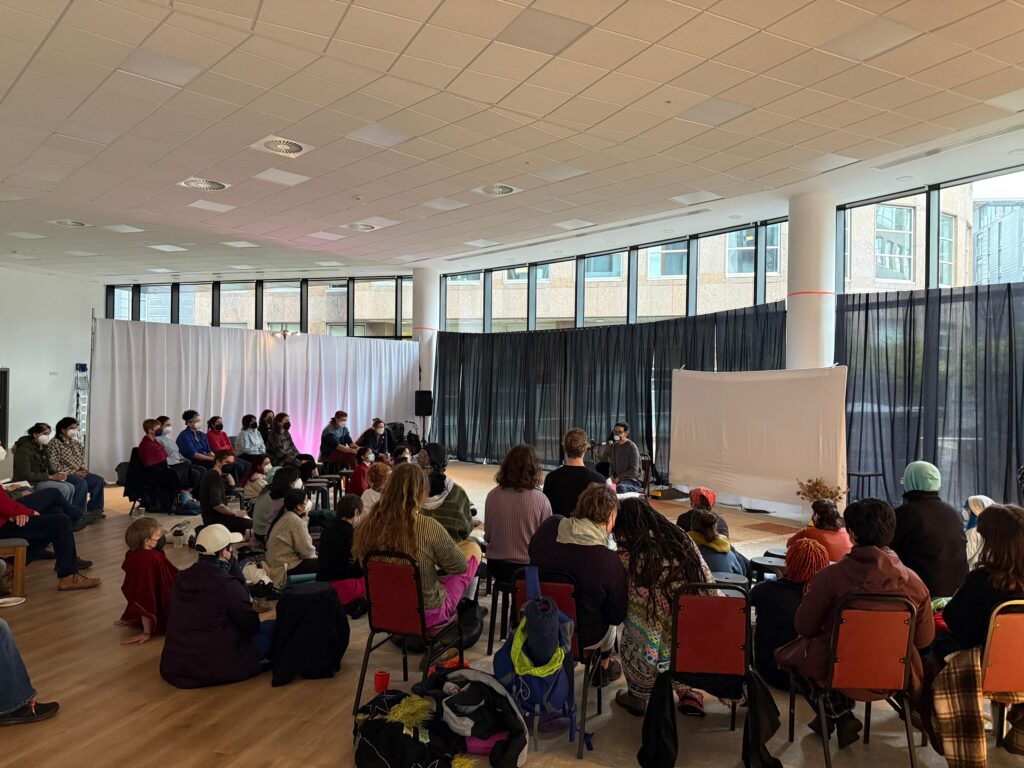
Partnering with Exhale, a grassroots organisation creating care-full spaces for QTIPOC+ (Queer, Trans and Intersex People of Colour) in Glasgow and across Scotland, felt especially meaningful. Exhale exists to make space for dreaming, connection, and imagination, and that work cannot be sustained without tools for stabilising, building trust, and practising collective care ( which Exhale is already doing).
The level of interest in the Glasgow session was both heartening and sobering. It was a reminder of how tired many of us are, and how deeply we are searching for ways to stay engaged without turning on each other or burning out.
What This Work Makes Possible
My story is not unique. Many of us are living with layered trauma, past, present, and ongoing ,while trying to organise within systems that continually harm our bodies, relationships, and hopes for futures.
In spaces that describe themselves as radical,we often ask people to show up with clarity, accountability, and political integrity, without having the tools and practices that are needed to do that work well. The result is often conflict, fracture, and loss not because people don’t care, but because care is not being structurally supported.
The Resilience Toolkit offers something deceptively simple and deeply political: practices that help people notice what is happening in their bodies and relationships in real time, and build the capacity to respond rather than react. This is essential for movements that want to be sustainable.
Reflections on Contextualising the Work
One important reflection I have is about contextualising this work , particularly for communities like the Sudanese diaspora, but not only.
For many people, care and healing are understood through faith, spirituality, and collective cultural practices rather than therapeutic language. This does not make the work irrelevant; it means it needs to be held and spoken about differently. Doing this well requires time, trust, and resourcing, including money, to build relationships and translate/contextualise the work without placing the burden on those already most impacted.
Carrying This Forward
For me, the biggest takeaway is practice. Continuing to ask myself, gently and repeatedly:
How do I know? What is happening in my body right now? Is it serving me and the moment I’m in?
This work is not about fixing ourselves so we can return to productivity. It is about staying in relationship, with ourselves, with each other, and with the wider world, while organising in conditions that are anything but humane.
The Resilience Toolkit and somatic practices offer social justice movements ways to build the capacity to stay present, intentional, and in relationship, especially under pressure. They support people to respond rather than react, to hold difference and tension with care, and to keep moving toward transformation without sacrificing our bodies or our humanity. Right now, that feels essential.
1 By radical, I mean spaces that explicitly seek to challenge systems of oppression and exploitation, and that aim to practise values such as collective care, accountability, justice and collective liberation in how people work and be together , not simply in what they say, but in how relationships, decisions, and differences are navigated.
About The Author:
Venus O’Shiel is a Sudanese trainer, facilitator, and organiser based in Glasgow. She has been involved in community organising from a young age. Growing up in Sudan, the experience of becoming racialised as a Black migrant woman, and becoming a mother in the diaspora continue to shape how she understands community, social justice, grief, care, and the messy and hopeful everyday practice of trying to live by our values. She is interested in how people learn together, build trust, navigate difference, and create more liberating ways of being with each other.
About The Rootwork Tour:
In November 2025, Healing Justice Ldn partnered with Lumos Transforms and local partners to seed the Resilience Toolkit across the UK in our Rootwork tour. Developed by Nkem Ndefo, the Resilience Toolkit is a somatic framework for first-stage trauma healing (stabilisation and resourcing) and real-time stress navigation.
We are honoured to have collaborated with our peers at Knowle West, WeCanMake, We Are More, Civic Square, Peaks of Colour, Migrant Action, NME Leeds & Exhale Group who enabled the Rootwork programme to happen across England and Scotland. We learnt a lot from them during this process and hope to continue doing this work together in the future. We extend deep gratitude to our long-term collaborator and friend, Nkem Ndefo for her commitment and rigour to this tour and this work, and to all of our contributors who wrote these blogs offering insights into the different ways Rootwork is applied across different contexts and realities.
The lived realities of perpetual burnout, in-fighting, conflict, rupture and exhaustion are reflections of the socio-political tensions we are confronting, and we understand that the more capacity and resilience we have, the more powerful and bold work we can do outside in the world. There is no structural change without deep inner-led change that uproots and attends to root causes.
Venus O’Shiel
13/07/2026