Why we need grief in our social movements
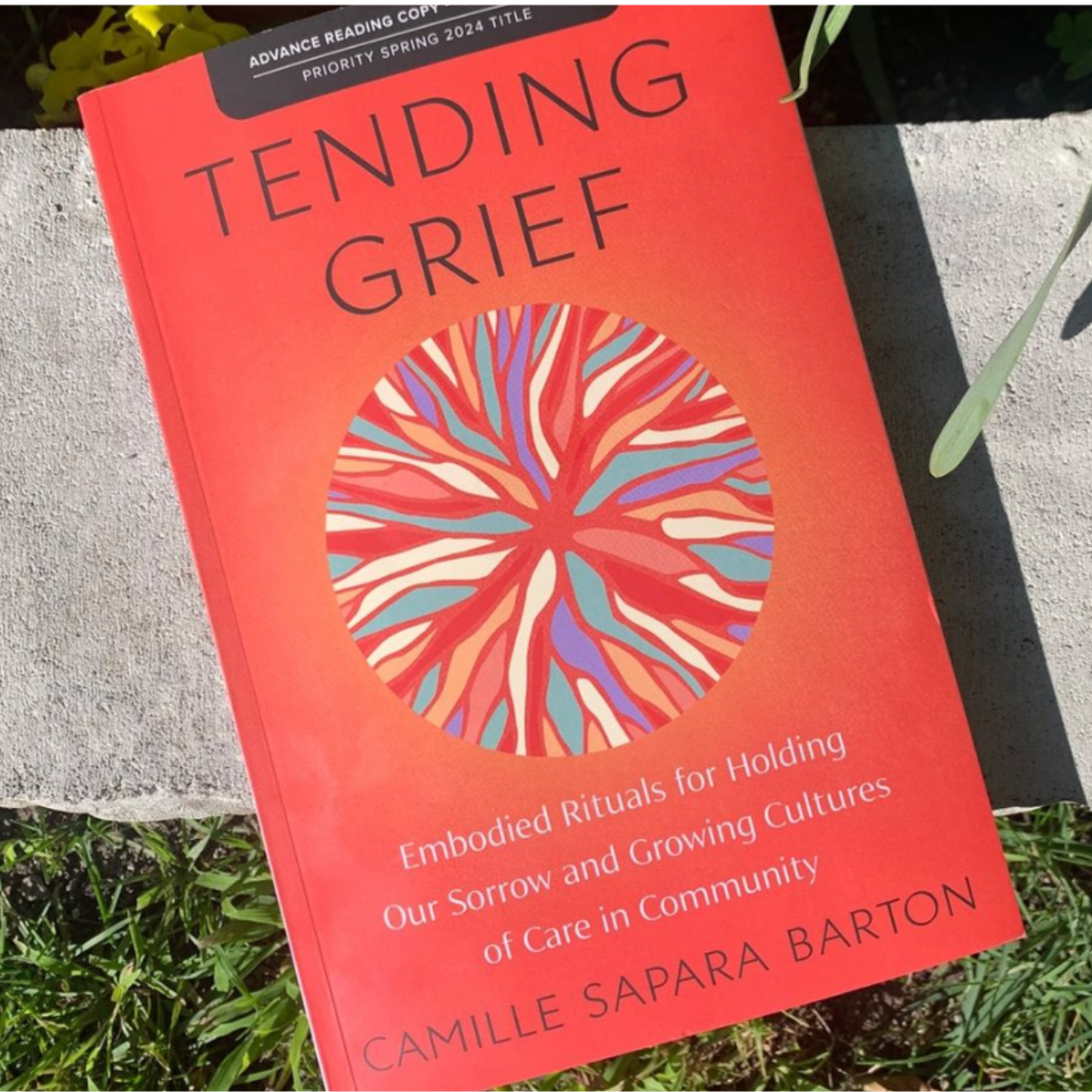
The Dagara people see regular grief tending as necessary for the health of the community. Why don’t we do the same? asks Camille Sapara Baron in this excerpt from their book Tending Grief
By Camille Sapara Baron
Commissioned by Micha Frazer-Carroll
The COVID-19 pandemic catalysed a collective grief experience on a planetary level. As I write this, we are still entangled with the loss, still finding our feet amongst the waves of new illness and disabilities that people are experiencing. All of this is happening alongside a state-imposed cognitive dissonance and forgetting that seems necessary for us to become productive workers and consumers again. In the snap back to being busy, we are being conditioned to bypass the deaths, the lack of care, and the racial reckoning and exploitation that have been laid bare during this time.
These dynamics have been taking place for many decades but are now clear for so many to see. We have a lot to grieve. However, we do not have many tools available to us. Given how much grief there is in this moment and how hard the market logics of late-stage capitalism encourages us to bypass our sorrow, in order to get back to “business as usual,” it is subversive to give ourselves space to feel deeply, to grieve and be witnessed in this within community.
During this collage of crisis many social movements have been organising, responding to emergencies, and trying to sustain life. I am grateful and heartened by this solidarity and collective action. However, I sense that many of these movements of courageous beings are not sustainable. There is no time to feel. Organising spaces are dominated with the logic of rationality; displaying grief or emotions in general is not seen as strategic. I recognized this within the English movement spaces I was an active participant in during my younger years. It became clear that if I did not tend to my emotions as they arose, I would not be able to stay involved with integrity.
Why is it necessary to incorporate grief into our movements? First and foremost, we have much grief to tend to and, like it or not, we cannot continue to compartmentalise—we must create space to bring our fullness into our movement work and find ways to hold that in agreed-upon ways. Tending to grief within social movements can support flexible thinking, conflict resolution, trust building, and somatic transformation within groups. These are factors that increase resilience and create supportive conditions for sustained movement work.
I identified as an activist for a large part of my life, from the age of twelve until a few years ago when it became clear that this label was no longer supportive for me. My interest in social change partly emerges from the deep grief that I have felt since childhood—the pain of witnessing the choices so many people in power were making that were causing deep harm.
In most of the movement spaces in the UK that I have been involved in, the approach has been to prioritise strategy and mental reasoning for specific outcomes or actions. This is understandable as a lot of work is done in the moment in response to urgent situations that need attention. However, I felt we were not making time to sense into the body, to feel the emotions present for people in relation to what we were doing or trying to change. The culture was generally to put on a mask, suppress feelings, and then use substances to numb or disconnect from what was emotionally emerging. I struggled for many years in movement spaces due to this tension between people’s politics and their behaviour. Overall, I saw theoretical knowledge prioritised over practice.
Grief, therefore, was definitely an unwelcome visitor. With all the heavy injustice, study, and strategising that is being done to address state and social harm, grief is the elephant in the room in organising spaces—it’s constantly being shoved down, swallowed, drunk, or numbed away so that activists can continue to function in this logic-dominated dance. As counterintuitive as it feels, embracing grief in agreed-upon containers would bring so many treasures to this work.
When we set down what is too heavy to carry, it creates more space to think in a flexible way, to orient from a place of love rooted in what we care about and how we wish to operate in integrity. Tending grief can support us to feel more choice and support us to resolve conflicts, build trust, and engage in somatic transformation as a group—changing ways of being that have become automatic. These are all factors that create supportive conditions for relationships as well as sustained movement work.
During my time living in the San Francisco Bay Area, I was deeply moved by the way in which the Black Lives Matter movement incorporated grief rituals and vigils into their protests. The incorporation of vigils provided connection and catharsis for those in need of collective grief space, as well as a strategic approach to honour beloveds killed by police, while at the same time demanding change. Seeing hundreds of people with candles and pictures of the dead was visually beautiful and brought out a feeling of collective reverence. Black Lives Matter protests also provide a much-needed container in which to hold the intergenerational sorrow of having to contend with the ongoing grief of colonisation in the form of state violence that has been manifesting in various forms for over five hundred years. When people are together with their pain, the isolation that can feel so heavy with grief dissipates and gives way to connection, a space where solidarity can grow and flourish.
In their essay “Grief Belongs in Social Movements. Can We Embrace It?” Malkia Devich-Cyril notes that their unaddressed grief initially caused them to spiral into work as a coping mechanism. Once they eventually did embrace the need to feel it, they discovered that grief is not an enemy to be avoided. They write: “In fact, resisting grief led to my suffering, while becoming intimate with grief led me to the lesson that grief and joy are inextricably linked. Though generations of traumatic loss can become conflated with deformed expectations, standards and culture, grief in all its forms has the potential to bring us closer to the truth of the world, to make us more tender and more filled with delight.”
Most of the organisers in movement spaces I have witnessed in the UK context have not incorporated grief work into their protests or organising strategy. As a result, many movement spaces can often be devoid of overt joy, pleasure, or sorrow. By suppressing many feelings, other than rage, these spaces can often become places where people feel the need to perform an idealised version of what an activist “should” be.
So, what can tending grief do for our social movements? What would it look like to weave this into ways of working? Before I share some examples, I will uplift two ancestors who are instrumental to the way I think about grief.
Malidoma Somé and Sobonfu Somé were Dagara elders, Indigenous to Burkina Faso; both were instrumental in spreading grief practices through the Western world. I was lucky enough to attend one of Sobonfu’s grief rituals in 2014 in California, an immersive, durational grief ritual of over five hours that involved a variety of altars, peer-based community support, and drumming throughout. It was a powerful taste of what grief work in the community can look like.
The Dagara people have a very different approach to grief than the Western world. Rather than being taboo or something to hide from public life, the Dagara see regular grief tending as necessary for the health of the community. Within Dagara customs, the entire community is expected to attend a monthly grief ritual because they believe that unaddressed grief becomes harm that impacts the community. As a result, personal grief work is not seen as an individual issue because what can begin as something with limited impact can ripple through the collective if it is not given the space to be felt and experienced.
Within the Dagara cosmology, the suppression of grief in the West means that we have a huge amount of harm spreading and rippling as a result of what has been left alone to fester. It is akin to a pile of rotting food that smells terrible, impacting the environment around it, rather than a well-maintained compost heap that can be used to nourish the broader eco-system. There is so much pain in modernity, so much isolation, and many people are finding ways to cope with this by numbing it away with alcohol or other substances because existing with all the feelings is too much.
I am not Dagara but I am influenced by their cosmology and approaches to tending grief. When I look at movements that I have participated in and acknowledge that much of the conflict I have experienced unfolded in these spaces, I am curious if a great deal of this arose from unprocessed grief?
Hyperindividualism would have us believe that we are all islands unto ourselves and the actions of our ancestors have no bearing on our lives. However, research in epigenetics suggests otherwise. We often carry some of the stress and traumatic legacies of our ancestors in our bodies, as well as their wisdom. As a result, we may enact and unconsciously perform the same forms of behaviour they did in their lifetime due to a host of factors. Therefore, if you are invested in creating a more care-filled and equitable world, it is worth tending to the dirty laundry of your ancestors for the benefit of yourself and the collective.
Tending grief can support embodied transformation by increasing somatic awareness, opening, and practice. Ultimately this can lead us to behaviour change on an embodied level which is a useful tactic and skill for movement folks to have at their disposal as we are often interested in creating new culture or changing it. According to Staci K. Haines:
“Our deep patterns, survival strategies, beliefs, and reactions live in our somatic structures. By this I mean, live in our tissues, muscles, and organs in patterning that includes, but is not limited to, our well-travelled neuronal pathways. These embodied patterns are supported by our habitual practices and are often reinforced by the structures and systems in which we operate; organisations as well as the broader social structures.
The embodied or survival-based habits cannot be changed through conversation or thought alone. The language centres in the brain have very little influence over the survival centres in the nervous system and brain.
At the same time, language and thought are important. In the big picture we want to align the head, heart, gut, and actions.”
Instead of hindering us, perhaps connecting to political somatics alongside grief work can create the foundation for communities of practice that are in deep alignment, and experimentation towards the world we wish to see.
Engaging in embodied grief rituals can lead a group to develop the skills for coregulation—the ability of a person or group to calm the nervous system of another person or group in moments of distress. In a context in which people are open to grief and can detect embodied signs of distress, consensual interventions can be offered, such as inviting a person to release sounds that represent their feelings, shake if need be, or receive supportive touch. Skills from grief tending can be applied to other moments when care is needed, deepening trust within organising contexts.
Tending grief is also a mechanism for building trust. If someone can hold space for you at your most vulnerable, you are more likely to feel deeper solidarity and camaraderie with them in situations when the stakes are high. Grief rituals also enable moments of slowing down so we can be present without bypassing, and choose collectively to acknowledge what is present even if it may be challenging.
Grief also connects us to something we all universally share—the process of loss. As Audre Lorde reminds us, it is important to celebrate our differences, yet simultaneously I feel it is powerful to acknowledge what is true for all of us. We will all die. We will all have to be separated from those we love and may struggle when these things shift. We have much to gain by learning to hold space for these transitions which are near universal for all of us.
Tending grief can support flexible thinking, conflict resolution, trust building, and somatic transformation within groups, which are all factors that increase resilience and create supportive conditions for sustained movement work. Some practical ideas to experiment with could be hosting a monthly grief ritual in your community, or doing this on a smaller scale in a pod of chosen people, or even beginning to experiment with creating some space for twenty minutes for a grief check-in to see where people are and what is on their hearts before going into a meeting.
I hope that social movements will warmly embrace grief work as a generative thread within organising. May we move with integrity, rooted in love rather than scarcity, making strategic and skillful use of our anger, so we avoid domination. May we grow holistic movements that can sustain us, be experimental, and embrace all our parts.
–
This is an edited excerpt from Tending Grief: Embodied Rituals for Holding Our Sorrow and Growing Cultures of Care in Community by Camille Sapara Barton, published by North Atlantic Books, copyright © 2024 by Camille Sapara Barton. Reprinted by permission of North Atlantic Books.
Related

Community grieving in the endz
Sara Bafo shares her reflections on grief and healing in the endz
Grief + joy befriend
AJ Venturini explores how grief and joy are deeply interconnected in the process of personal transformation and collective liberation
Disenfranchised Grief
A dance film by Diana Amma Gyankoma
A concrete camp: embodying collective resistance for Palestine
Musings on a student encampment
Intersectional alchemy
A poem by Marai Larasi
Holistic expeditions of a somatic cartographer
Evie Muir explores and navigates the body as a landscape.
Second Lives
Musings on a second life by Chloe-Louise Adegoke and illustrations by Isha Joy

Is pain always political?
An excerpt from Sophie Chauhan’s book Curious Affinities