A concrete camp: embodying collective resistance for Palestine
Musings on a student encampment by Harvey Brown

“As community members, we are collectively responsible for each others’ welfare and safety. Our solidarity with Palestinians must be embodied as an act of collective resistance against colonialism and all forms of oppression.”
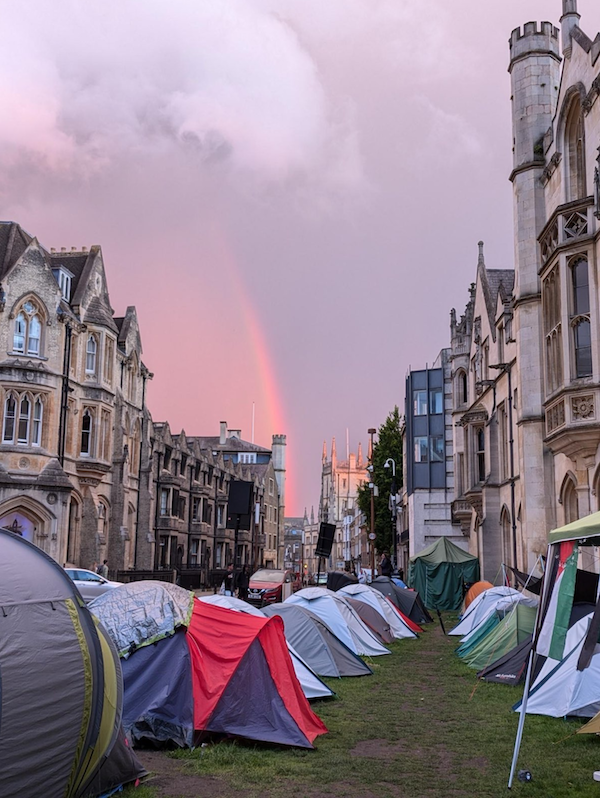
The University of Cambridge invests heavily in companies enabling Israel’s ongoing genocide of Palestinian life, collaborating with the so-called ‘defense’ industry producing and profiting from the warplanes and drone technologies used by states across the world to dispossess, surveil and murder. In May, as part of a massive wave of student encampments set up in solidarity with Palestinians, students and workers in Cambridge set up tents and gazebos under King’s College chapel on King’s Parade, the tourist centre of the city. For 100 days we held a space in protest of the university’s participation in Israeli colonisation, which stretches back to the Balfour declaration of 1919.
In the shadow of the university’s long colonial history, each day in the camp began with a recognition of the scale of what we’re up against, as well as the power we hold to build and embody a resistant alternative. In the morning, campers assembled to read through community guidelines together, as the city centre slowly woke up around us. What had been an empty patch of lawn saw us rally, organise, grieve, plant, dabke, eat, play, sleep, learn and grow in community.
There are other ways to embody solidarity, of course. Much of this year we have experienced a darker way, a lonelier way. To bear witness to a horror beyond comprehension from the quiet of a bedroom; the long journey home after a weekly march; swiping between instagram stories on the way to work. Trying to simply move through the world ‘normally’, to hold genocide alongside the office, the supermarket, the pub, the kitchen. Before joining the camp many of us were not well, unable to conscience the apathy and depravity of daily life. I hadn’t recognised the hopelessness which had spread through me since October until suddenly I couldn’t really see anything else. Our bodies can’t be okay if those around them are not – at least if they truly understand the people being brutalised to also be human.

We cannot pretend, whatever freedoms we have access to that others don’t, that we are free. Our mental health is political and hopelessness is structural: our social environment limits the possible futures we can imagine, whether visibly and violently – the police vans encircling the march for Palestine – or through absence and quiet austerity – where can you go when the hopelessness is too much to bear? What structures exist to affirm your fading belief that it doesn’t have to be like this?
Structural hopelessness necessitates collective resistance. Collective embodiment needs a space for people to be together in resistance for their pain and grief to be deprivatised and understood through shared political struggle. When we are forced to pay an entry fee or put our names on a wait list to access spaces for gathering, hoping and healing, setting up a makeshift camp is a form of active resistance in itself. That we gather together in the struggle for Palestinian liberation embodies international collectivity and solidarity.
In this embodiment of solidarity we create lasting structures of hope. My favourite memory of camp is building our community garden from broken tents and donated pallets. We planted flowers and vegetables significant to Palestinian culture, raised awareness of Palestinian resistance to Israeli ecocide and land-theft, and wanted, in place of the Cambridge lawn monoculture, to demonstrate that an abundance of life can grow when public space is looked after by people, not landowning institutions. The garden was a place, however small, to come and be still, to people-watch, and to imagine – even for a minute – a different kind of world.
‘How long will you be here? people often asked stewards, implying that the camp would always be a temporary project, or, worse, that the camp was an empty symbolic action, not a living community. Protests can sometimes feel like this: contained, passing, leaving no trace as people return to individual lives constructed around the workplace, the home, the family. What happens when a protest starts to become home, however? When resting, eating and socialising, are not separated from action, but part-and-parcel of a political project? In the encampment, fragments of hope were soldered into a life, however strange and precarious.
Seeing the community come together in new ways, in greater numbers, in unbelievable generosity, was testament to years of dedicated organising. But the camp also restored beliefs which, in our individual struggles to reckon with the horrors of the last year, hardly seemed possible: that genocide is not an inevitability, that numbness is not permanent, that we will see a free Palestine in our lifetimes.
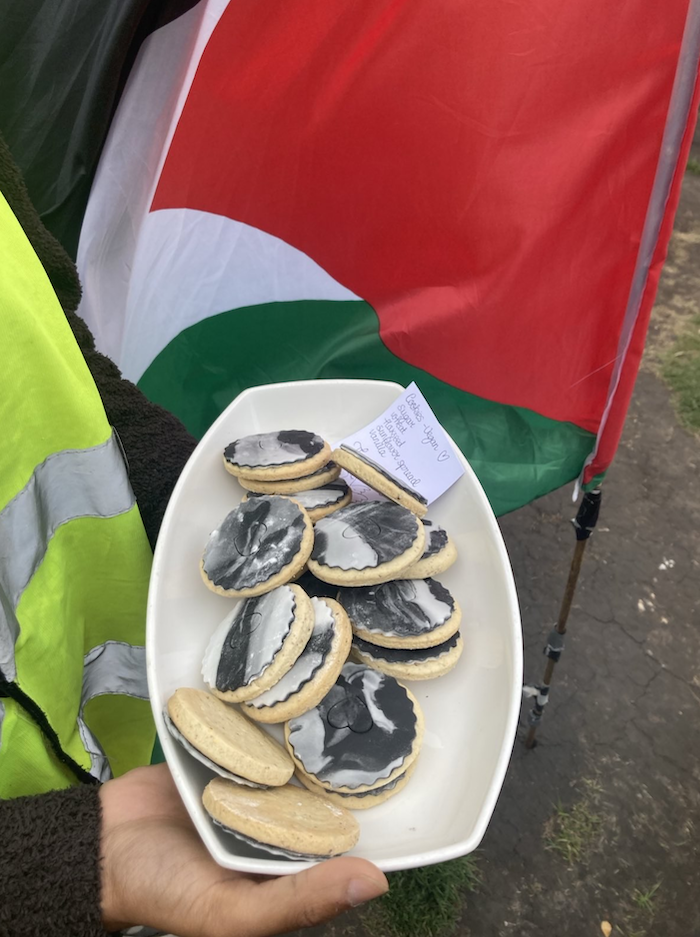
Outsider observers may have classified the camp as a single issue – we were there for Palestine. But, like Palestinian liberation, our camp connected across issues and many strands of state violence. While we embodied solidarity with Palestinians, we also extended solidarity with those around us. We supported neighbours experiencing homelessness, created spaces for children to come and play on the weekends, and facilitated students and community-members alike to develop new relationships with the city, no small achievement in a city marked by ‘town/gown’ divisions.
In this we came to understand – and integrate into our demands – the relationship between the university’s investments in settler-colonisation, genocide and apartheid, and its position as the monopoly landowner in the city, holding fast to its role in gatekeeping and privatising space and denying community. To address and repair the harm done by Cambridge University, we had to holistically consider the infrastructure that is missing in the city – or what has been denied by the institutions which shaped the city – and how, even on the small patch of land that we were camping on, we could start addressing these absences. ‘As community members, we are collectively responsible for each others’ welfare and safety’: this is an ongoing challenge as well as a commitment to care.
Structural hopelessness makes the future seem terrifying. But in new structures, physical and relational, which grow, break and are repaired, the future we desire and deserve can come to feel possible. As in a choir – and the camp was always so full of music – when one person stops breathing, other voices take their place, locking into harmonies, lifting together and building song.
Since the end of the encampment (we decamped in August as the university agreed to begin meeting our demands) I have been thinking a lot about Sahar Khalifeh’s My First and Only Love, a novel which parallels Palestinian resistance to the British mandate and Palestinian survival under occupation in the present-day West Bank. Nidal, whose name means ‘struggle’ in Arabic, falls in love simultaneously with Rabie, a revolutionary, and the connection to the land embodied by the revolutionaries’ struggle. Under curfew in the confines of her home, an older Nidal describes how this love felt:
love was the strangest thing on the face of the earth. Why did I see the world as beautiful despite the sadness and the miseries of the war? Why did I feel happy, though people were miserable? […] Love was an extraordinary thing, and the revolution was even more extraordinary […] the beautiful world and limitless horizons [which love fashioned] could have covered immeasurable spaces, forests, valleys, the wheat fields in my country, and mountains that rose to the limits of the sky […] rain and thunder and storms that left behind winter lakes and created nests for birds’
The struggle and hope of Palestinians exposes the limitless horizons of a revolutionary love which could – and can – cover immeasurable spaces, rooted in restored ecologies and connection with the land.
Solidarity can create spaces to heal and hold each other through the embodied pain of the present in anticipation and practice of something better. Whatever happens to our movement – encampments all over the UK are facing increased police violence, zionist aggression, and eviction by university administrations – I remain so grateful for the comrades who nurtured hope in this space.
Every morning we closed our reading with one final community guideline, added once we realised the power of the space we were holding:
“This is a space in which we turn our vision of a better world into a lived reality. Our efforts to create the world we want to see are embodied in, while also extending beyond, the physical existence of the camp.”
This remains a promise, to ourselves and to all people. A collective embodiment of solidarity can heal all kinds of wounds, individual and collective. Encampments across the world are making the future in their neighbourhoods as well as fighting for justice for Palestine, providing mutual aid, community learning, and, crucially, spaces to resist a cruel system which imposes misery and premature death across our communities. While the camp may now be gone, possibilities of permanence remain.
Related

A Juicy and Definitely Scientific Qualitative and Quantitative Comparison of Cure vs. Care
Poetry of care by Miriam Saperstein
Convalescence
Poetry and free writing exploration of convalescence by Saskia Horton
aftercare/devotion
A digital oil painting of trans care by Mercy Thokozane Minah
Care Under Capitalism: the work of health and sex
Care Under Capitalism — the work of health and sex by S.N.H.
Intersectional alchemy
A poem by Marai Larasi
Why we need grief in our social movements
The Dagara people see regular grief tending as necessary for the health of the community. Why don’t we do the same? asks Camille Sapara Baron in this excerpt from their book Tending Grief