Community grieving in the endz
By Sara Bafo
Grief runs deep in the endz, a familiar sensation that travels from home to home. One call and your life is altered; one walk outside, and everything changes; one moment.
I remember the first time I saw a police cordon. There was the white tape stamped with blue. The area was encircled by flowers [a sparkle of beauty against the violent backdrop]. The night before, my siblings and I had heard a loud bang. As a child, all I could think was, who were they? Did they die? Did they survive? What happened?
The school day ended, the rumours travelled, and the police tape remained, but the flowers became less and less each day until the pathway was empty. Two decades later, the unknown person remains in my thoughts. Two decades later, I can no longer put a number on how many times I’ve seen police tape surrounded by flowers, how many times I received a call that altered my life and how many times grief has travelled through my body, becoming dislocated and disoriented. Every time that it does, I am reminded of James Baldwin’s words:
“You think your pain and your heartbreak are unprecedented in the history of the world, but then you read. It was books that taught me that the things that tormented me most were the very things that connected me with all the people who were alive, who had ever been alive.”
The fear never dissipates: will there be news of another death, another crisis or another situation where someone has been hurt? Will I go on my phone and bear witness to another atrocity? Will I read another book that paints the picture of our current reality – a reality of violence created by a blood-thirsty capitalist system?
When I received the call at the age of fifteen that my father had died, I learnt quickly that even death has become a money-making machine: we can’t bury our loved ones without a cost, and we can’t grieve without a price. The community showed up at our door amid our grieving and provided us with months’ worth of resources to sustain us. They completely shattered the individualistic capitalist idea that is taught to us, shattered the idea that grief happens in isolation, that our trauma is ours alone and we must suffer in silence. Now, I show up at my neighbours’ homes who receive similar calls; we gather and grieve.
Community intervention as a lifeline
I worked in a community centre on an estate where community intervention was normalised. If the police came onto the estate, most people would know. The word would spread across blocks to keep each other safe. Far too often, we witnessed the police harass and brutalise people from block to block, on street corners, in front of schools, in front of homes and, of course, in front of the community centre where I worked. I would enter the estates, and the first thing I would witness would be a police officer cycling the estates, a visual representation of surveillance, so we had to watch the police and their movement; we had to resist. Community intervention is not an abstract theoretical concept that stays within the walls of academic conferences; community intervention is a lifeline, a practice rooted in keeping each other safe from state violence and addressing interpersonal harm.
The community intervention practice has been passed down and sharpened over the years amid grief. On January 1st 1987, Trevor Monerville was arrested and held incommunicado in Stoke Newington police station. He went missing from Stoke Newington police station, reappearing in Brixton prison days later with injuries and subsequently undergoing emergency brain surgery to remove a clot. On June 25th 1987, Tunay Hassan died in police custody at Dalston Police Station. On November 5th 1987. Seven off-duty police officers physically assaulted Gary Stretch. In response to police brutality, the Hackney Community Defence Association (HCDA) was formed on July 2nd, 1988, as an act of refusal, resistance, and community intervention. The HCDA was a coalition of family and friends, justice campaigns, and anti-fascist groups. The group set up mutual support for victims and campaigns against the police alongside self-help community groups for the victims. Throughout history, there has been a long history of resistance within communities that bear state violence and are filled with grief.
How many of my brothers and my sisters
will they kill
before I teach myself
retaliation?
Shall we pick a number?
– June Jordan
I recall a time when a person in our community was having a mental health crisis. Instead of calling the police as we’re told to do when someone is in crisis, we knew this would only make things worse for our neighbour. Instead, our community came together to create a plan to support the individual’s immediate needs; the community leaned on each other. A plan was developed to support the person’s immediate needs. Have they eaten? Are they injured? Has the person requested a specific type of support? Does the person have an immediate support network we can call? Is the person housed? These questions were asked and answered while others tried to assess what had occurred to lead to the person having a mental health episode and what long-term support looked like. The short and long-term plans were developed alongside the person who needed/wanted support at the centre, giving them autonomy.
The purpose of naming this experience is not to romanticise and simplify the experiences of community intervention – it is not easy, lessons will be learnt, and usually, the first respondents are those who have experienced interpersonal harm and state violence. Still, every time we are called to respond to a crisis, I remember Olaseni Lewis, Mouayed Bashir, Kevin Clarke and every person who was sentenced to state-sanctioned murder. What choice do we have other than protecting each other?
The fascist police state we are under has created unliveable conditions to profit off our misery. Whilst working-class communities are depicted as ‘gang-ridden’, ‘no-go zones,’ ‘drug hotspots’, and the media perpetuate these racialised narratives of the ‘war on gangs’, which has been a dog whistle to justify state-sanctioned violence on racialised working-class communities. We have witnessed public health cuts, the housing crisis soar, and our tax money going into funding genocides in the Global South. People who are unhoused, people who need mental health support, and young people in the system are demonised and scapegoated. The capitalist machine is functioning through the continual oppression of working-class communities. Our suffering and division are keeping the capitalist machine functioning; our enemy is not our neighbours who are struggling to find the next meal, the young people roaming the endz, the person who is addicted to drugs and vilified in the community.
There are necessary conversations in the community about how we address harm, conflict resolution and community accountability – the goal is rooted in addressing violence without causing more violence, without relying on a state that is rooted in structural violence and the oppression of disabled people, poor people and racialised communities. We are all under threat from a capitalist system that renders us disposable. The capitalist police state is rooted in protecting and serving the pockets of the global elites and not serving our material needs and the process of healing. We cannot heal under capitalism; we can create mechanisms to survive, to gather, to hold each other, to learn how our bodies feel and process our traumas and learn to release trauma through our ancestral practices. We must remove the poison that is making us all ill.
The Endz, through an internationalist perspective
Throughout my organising over the years, particularly through supporting young people in the endz, I’ve attempted to connect systemic violence in working-class communities to broader global struggles against capitalism-imperialism. To fully understand the trauma roaming our communities, we must name the enemies that have contributed to the conditions on the ground.
“When you recognise who your enemy is, he can no longer brainwash you, he can no longer pull wool over your eye so that you never stop to see that you are living in pure hell on this earth, while he lives in pure heaven right on this same earth!”
– Malcolm X
We live in a country that has stigmatised and criminalised our communities. I am filled with grief for what could have been if our world wasn’t controlled by capitalism – grief for Black youth who are forced to grow quickly and become adultified. Grief for our political prisoners, our resistance fighters and martyrs. Grief has moved me to organise; where there is grief in the endz, there is resistance in the community and globally. Where there is grief, there will be healing, and not through a capitalist, individualistic approach. I want us all to heal in a way that leaves no one behind. I want us to address the roots of the problems. I want us to bury our loved ones without worrying about the price. I want to heal, but never at the expense of harming another person across the globe and never at the expense of harming another person from a different block.
References:
https://poets.org/poem/i-must-become-menace-my-enemies
https://www.marxists.org/subject/africa/rodney-walter/works/partition.htm
The Autobiography of Malcolm X
Related
Disenfranchised Grief
A dance film by Diana Amma Gyankoma
Grief + joy befriend
AJ Venturini explores how grief and joy are deeply interconnected in the process of personal transformation and collective liberation
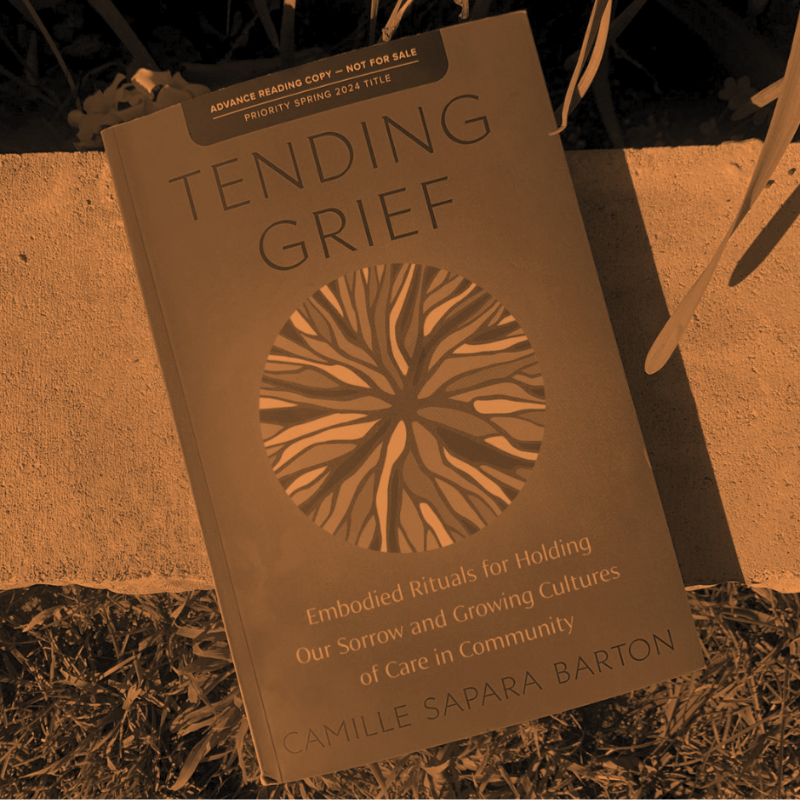
Why we need grief in our social movements
The Dagara people see regular grief tending as necessary for the health of the community. Why don’t we do the same? asks Camille Sapara Baron in this excerpt from their book Tending Grief
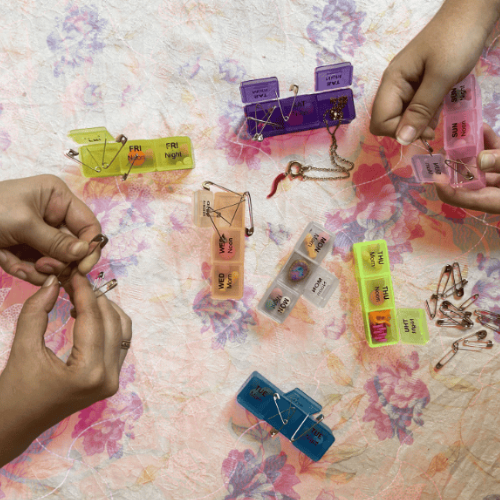
Beyond Pills: Mapping Community Care through Memorabilia
A photo essay by Divya Mahatme exploring moments where care is both a gift and a loss.

Convalescence
Poetry and free writing exploration of convalescence by Saskia Horton