Somos fuego: Amulets from the Locus* project
By Nada Colectivo
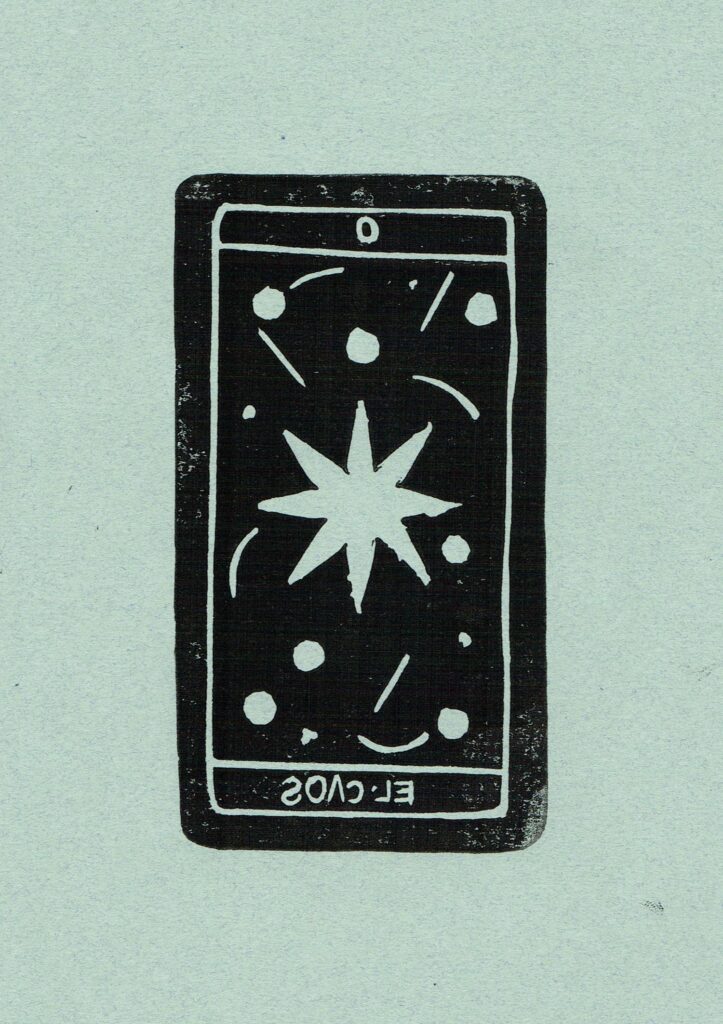
By Ana
“My amulet represents a tarot card featuring an eight-pointed star at its centre, similar to the asterisk in the Locus* logo, surrounded by small dots and lines that evoke a night sky. The inscription “CHAOS” appears deliberately inverted, symbolising the importance of placing error at the centre, rather than relegating it to the margins. This reflects both the experience of approaching the technique of printmaking for the first time, and that of sharing our madness together: a vulnerable process, but one full of infinite possibilities, sparked by the magic of this first workshop. A sort of supernova in the face of the coercive treatment of mental health struggles.”
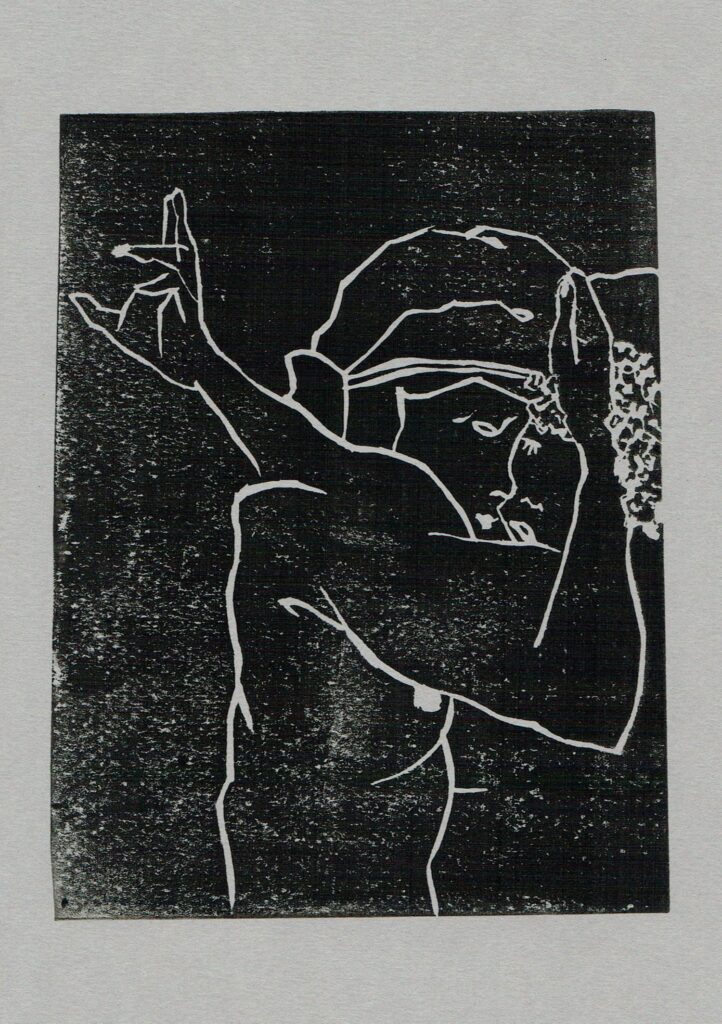
By Fran
“My amulet depicts an embrace between two women; it’s taken from a painting by Klimt. It evokes tenderness, sisterhood, sorellanza, the mutual support I discovered only later in life. It reminds me that tenderness can be just as powerful a weapon as rage. The act of engraving an embrace with a blade crystallises these two contrasting realities.”
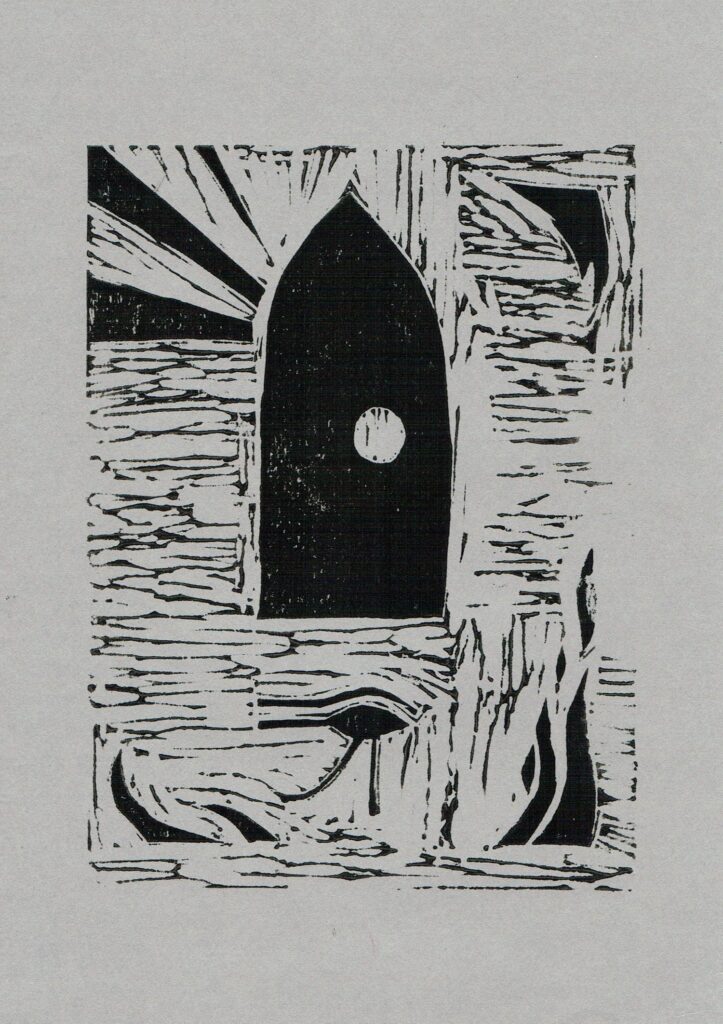
By Iris
“My amulet bears witness to my first approach to printmaking, where I allowed myself to navigate the emotional vulnerability of feeling and expressing. From the bottom up, on top of waves that are both fiery and watery, appears the Eye of Ra – an Egyptian symbol, from the country where I spent my childhood, and also a symbol of “daring to look” at what is usually ignored. Above it, an open and deeply dark door, through which a moon is just visible, with rays emerging from it. The duality of darkness and light coexists within all of us, and often it frightens. The process of this workshop helped me connect with the greyscale that also shapes who we are, and added to that was the collective courage I witnessed in my companions. It makes it easier to dare to open doors.”
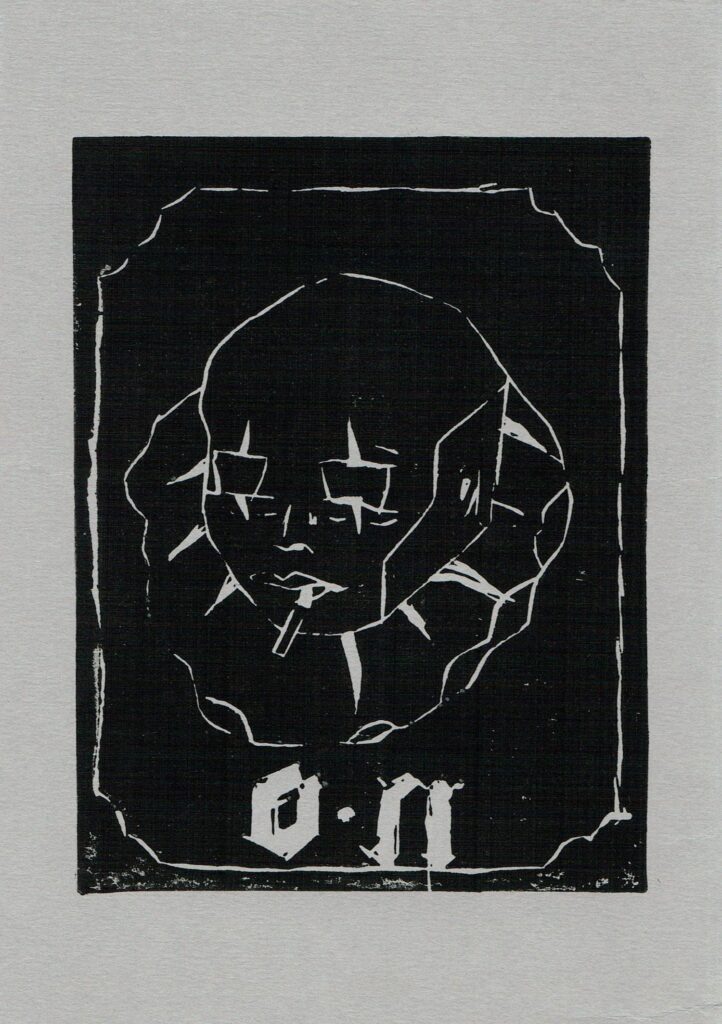
By Lucía
“My amulet is the tiny head of a clown – specifically, the clown from Le Soir Bleu by Edward Hopper. That painting resonated deeply with me at the time (and still does), as the clown appears in full costume, face painted, smoking a cigarette in what seems to be an ordinary café. And yet, he strikes me as the most honest of all the figures in the painting, who always seemed to be even more in disguise than he was.
I relate a lot to his figure in how I experience my mental health. Outwardly, I’ve always felt marked out and different, like the world has never quite adapted to the way I live it. And yet, in my “strangeness,” I often feel more truthful than many around me – who hide away or avoid dealing with their emotions. I’m proud to know that I don’t.”
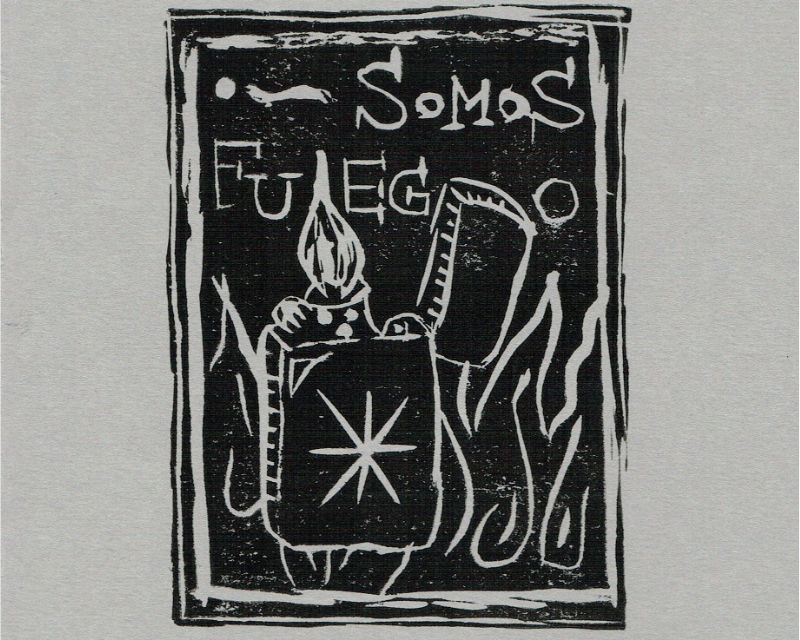
By Poppy
“My amulet is a lighter engraved with an asterisk (like the locus symbol), its flame lit, surrounded by fire, and bearing the phrase “We Are Fire.” I feel it’s important to say that this amulet was made using linocut, a technique that involves gouges. For some of us, who had been through hospital stays, psychiatric admissions, it was significant to be offered what were essentially blades upon first meeting. Trust can be healing.
For me, fire represents transformation and resistance. It speaks of the energy we share. Of destruction and creation. In community, fire also illuminates. What’s more, my mother had a similar lighter, and it reminds me of her. 🔥”
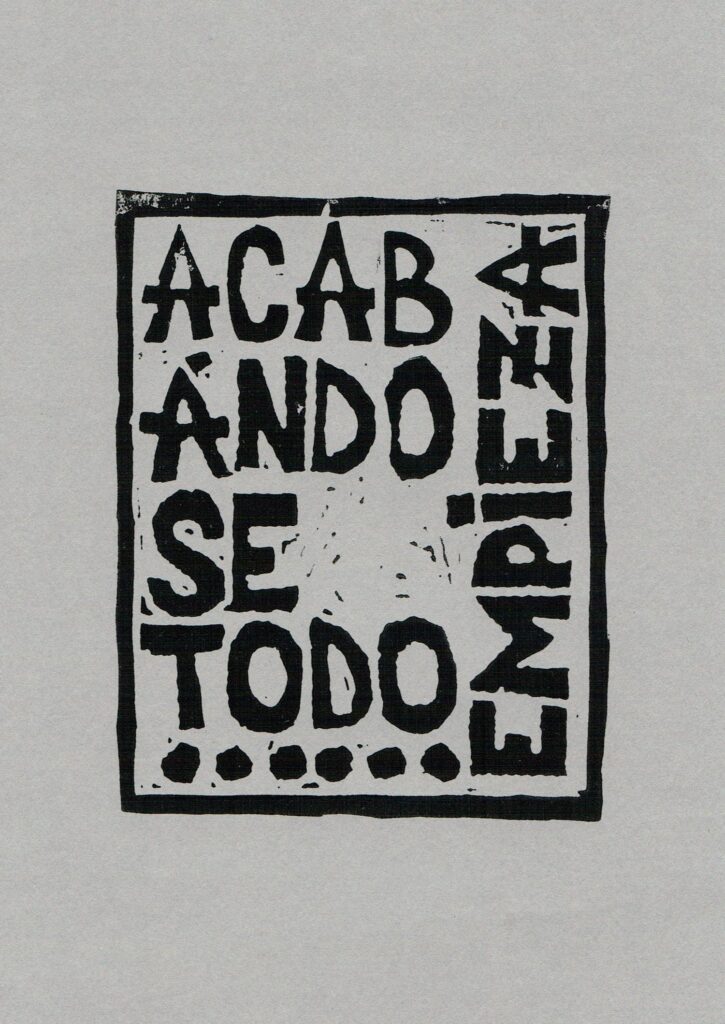
Rosana
“I chose a short poem by an artist who fascinates me – one that brings to the table the idea that every ending is also a beginning. Not from some sugar-coated, self-help perspective of “closing doors to open new ones,” or any of that pseudo-coaching nonsense. But rather from the viewpoint that we are not so important that our ending should mean the end of everything. It brings me great peace to think of myself as insignificant – to remember that existence carries on, even if I were to decide not to be part of it.”
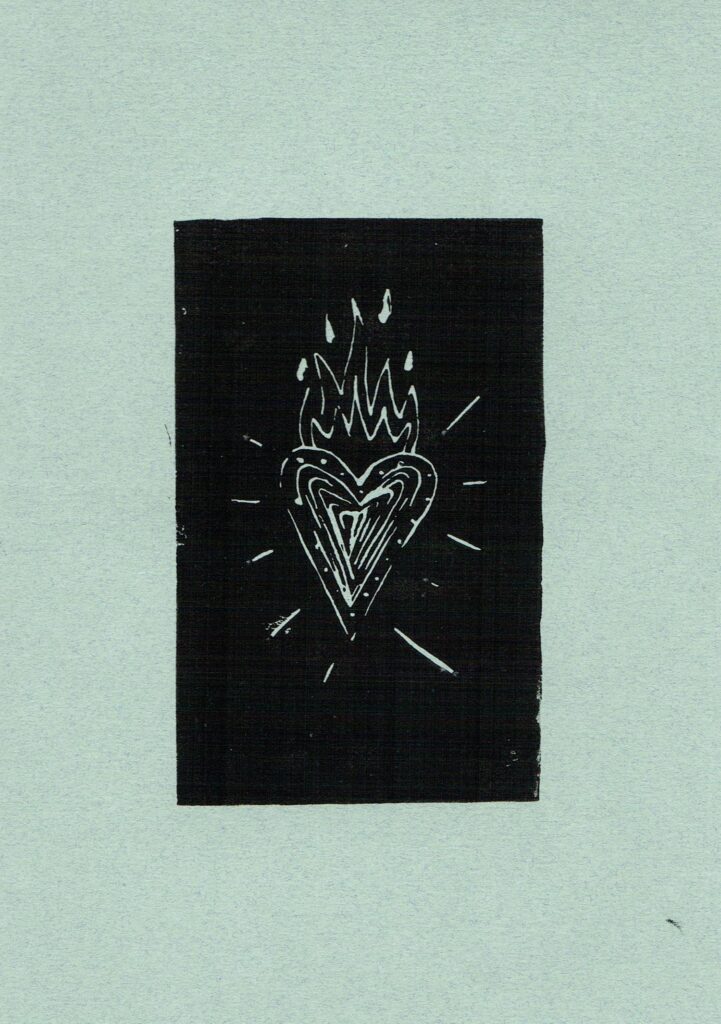
Clau
“My amulet represents a burning heart. It symbolises life itself, emotional intensity, and strength—a reminder that our heart still beats with power, that we continue to build, grow, and love fiercely, despite all the setbacks and attempts by the mental health system to dim our flame.”
Locus* is a thought-provoking project which examines the intersection of culture and mental health through a critical, community-driven lens. Challenging the conventional concept of a “place of safety”—often associated with institutional, police-controlled, or psychiatric environments—Locus* invites a reimagining of mental health spaces. The project explores how madness can coexist with solidarity and how creative, contemporary practices can be used to challenge existing norms.
One such practice was the Amulets Workshop, held in a reclaimed former operating room known as El Quirófano. Over the course of a weekend, seventeen participants came together to reflect on their emotional wounds and everyday struggles. Guided by Clau Sánchez-Manzanero Ponce, they transformed their vulnerabilities into powerful, symbolic creations through printmaking and collective care. The workshop offered not only tools for artistic expression but also a safe, affirming space where shared pain became collective resistance.
The project’s artistic output—comprising prints, memes, photos from a performance, and a micro-documentary—emerges from a series of workshops designed to promote the cultural rights of those who experience mental suffering. These workshops foster mutual support, aiming to create a space where conversations that are often silenced can take place.
Through art, Locus* not only sparks dialogue but also adds an asterisk to the ongoing conversations around mental understanding of well-being. Locus* is part of Nada Colectivo’s social impact. Nada Colectivo, composed of cultural workers Ana Campillos (Spain, 1993) and Francesca Alessandro (Italy, 1990), has been producing and mediating projects that challenge the status quo and contribute to social transformation. The materials generated from Locus* can be explored further through images, videos, and texts in
the online exhibition at proyectolocus.org.
Related
How do you feel?
A poem by Jolien Van Goethem
embracing the fiery madness of this here দুনিয়া
Companions in pain – SWANA Healing
Companions in pain – connecting and healing with SWANA Healing

The Light Between the Shadows
A photo series of light and shadows taken during Dianna O’Shannon’s stay in a psychiatric unit
it’s ok, you’re ok
Intro to psych abolition
Stefanie Lyn Kaufman-Mthimkhulu and Thokoza Ndlondlo explore the theme of psychiatric abolition and Mad liberation
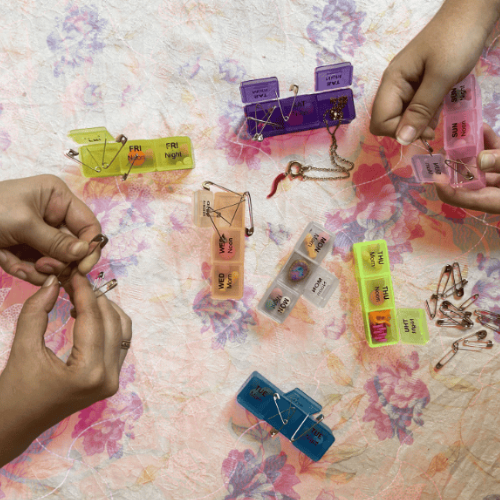
Beyond Pills: Mapping Community Care through Memorabilia
A photo essay by Divya Mahatme exploring moments where care is both a gift and a loss.
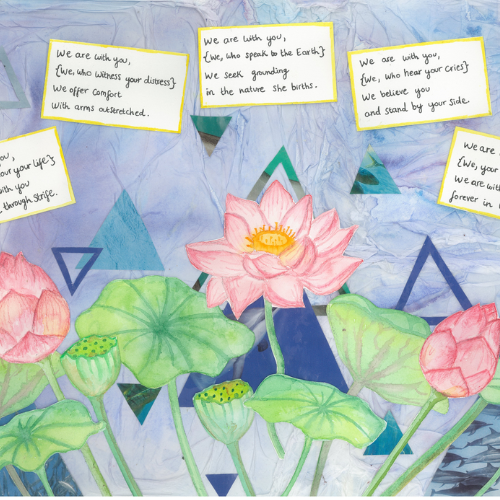
We Are With You
Handmade collage exploring community mental health care by Lydia Rose