Assisted Suicide / Assisted Joy
By Dolly Sen
My name is Dolly Sen and I am a disabled artist who uses subversion, irreverence and sometimes humour to draw attention to critical issues in disability, societal norms and institutional failures. I’m working class, Brown and Queer, and I’m a writer, filmmaker and activist who wants to disrupt systems that produce the programming called oppression.
Through creativity I have unlearned my conditioning. I no longer believed the scripture of self-hatred, I turned those pages into canvases to make sense of the world, to protest pain, to uncloak the horrors hiding beneath. The process of creativity itself is transcendent, it is like meeting the gods in the most unlikely of places. But I also create work because the world is dark. I am just lighting a candle to show where power and suffering is hidden and to demand more light. I have learnt to harvest rage and turn it into love and ferociousness.
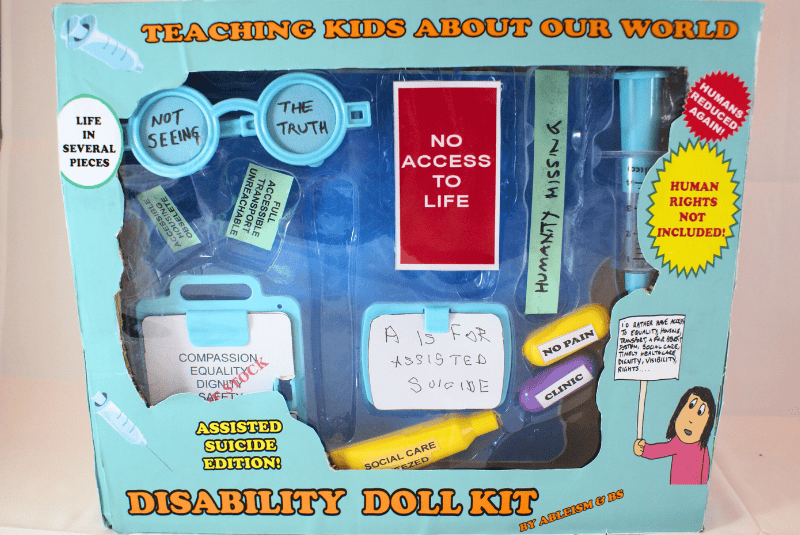
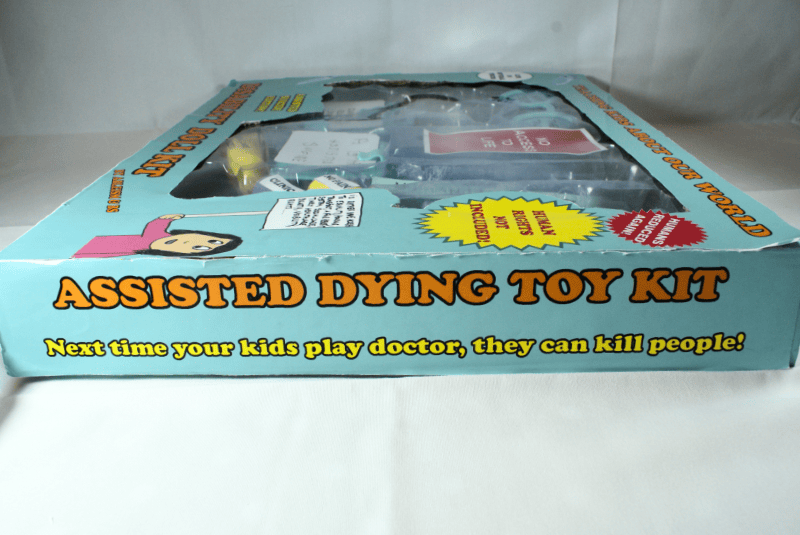
A recent motif in my work is subverting children’s games and toys to teach them about what the world is really like. I’ve created a Wendy House eviction, renamed the Monopoly game ‘Poverty’, and built a Lego Food Bank. I have also produced a set of DWP ‘Fit To Work’ dolls, which feature a coffin, a doll in a coma, a terminally ill doll, and a doll with multiple disabilities, to highlight that thousands of people died just after being deemed fit to work by the Department of Work and Pensions (DWP), and that dead people, terminally ill people and people in comas have been deemed fit to work by the Dept. of Work and Pensions.
Someone once called my work ‘aesthetically cool, but emotionally on fire’, and I think that’s about right. At first glance it’s easy or ordinary to look at, but the deeper you look, the more it disrupts mind and emotion, an existential fire-starting to both warm and re-light people’s humanity. I want people’s thoughts, biases and perceptions pulled out from under them when they confront my work, to make their inner world gasp.
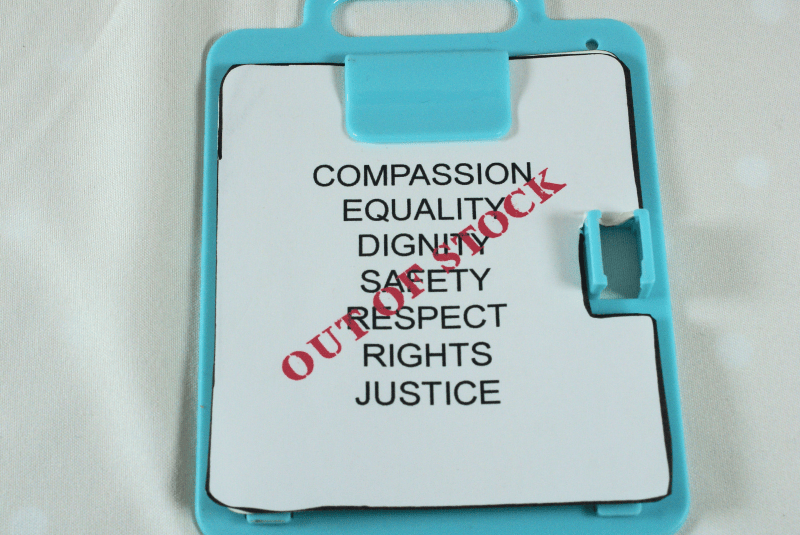
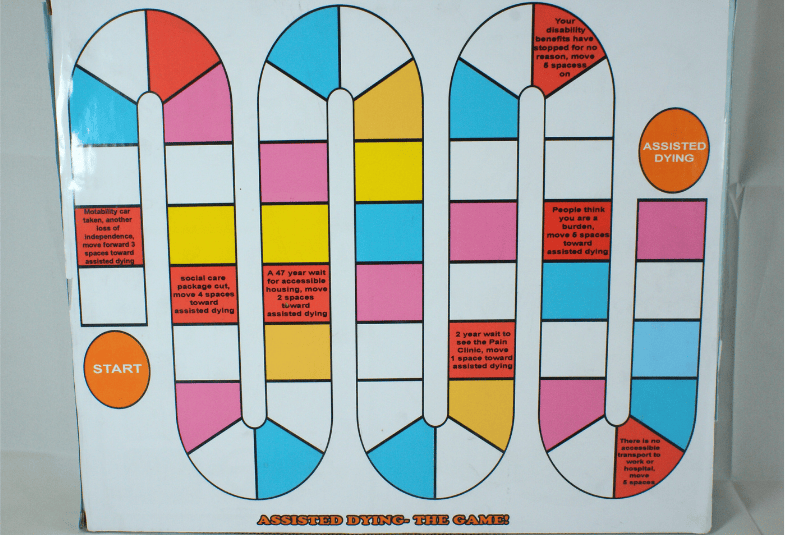
My creative process is just to plant an idea or an issue into my mind and leave my mind be – if I go and do something else, the ideas will come. I come up with random questions, such as: What kind of magazines will be in an assisted dying waiting room? Should I create one? What about a gameshow where the host says, “You’ve hit the bullseye of being accepted for assisted suicide! Here is what you could have won!! Accessible Housing! Compassionate Benefits System! Equality!” Can I make a toy explaining the disabled take on Assisted Suicide instead, like I have done with other issues?
As disabled people, through the process of being dehumanised, we investigate humanity. We see things as they are, also going beyond that, being a visionary about human decency, kindness and the right to being. When will life start for humans? The real juice and marrow of it? To go both deep into it and to go upwards as well, to transcend and meet the gods, meet that sense of aliveness? Disability Justice may be messy, but life in all its fullness is there, it is assisted being, assisted joyousness, assisted exaltation.
When we talk about disability justice, we are talking about a beautiful and gentle place to rest; we are tired of fighting. Instead of a medicinal intervention that feels like an enema put in sideways, it is a salve that brings ourselves closer to our ragged hearts. It is a place for being embodied in unrepentant flesh, saying f*** you to a world that gaslights our own relationships with our bodies, minds, our very being. It is a reclamation of bodies and minds; our hearts are our resistance movement. I will make my life beautiful enough to save my soul. Our artful justice is saying: you can’t hide us, we are too fabulous.
Our main defence and offence is our imagination. It has the power to change the story to be truly free and ours. My creativity is the thing that has given me my life back and a platform to reveal mad glory. Make no mistake, my life is uplifted. I am looking down at normality. In a world that wants us to disappear or at least hide with shame, I refuse to move out of the light. It is hard to tell people who are elevated, enlightened and respected that assisted dying is the best thing for them. Assisted Dying is the most perfect illustration of a failed loveless society. Disabled people say if you can’t love us, we have to love ourselves, until love isn’t a thing of shame but is seen as the only thing that will save us all.
The Deaths by Welfare Project investigates deaths linked to welfare reform and welfare state violence.
Dolly Sen appeared on episode one of the Deaths By Welfare Podcast. Joy Dove, mother of Jodey Whiting, appeared on episode five. You can find all the other episodes here.
Related
Maramiya
A painting of a Palestinian plant by Aisha Noble
Invisible Gifts
A short story by H K Grafton, with imagery by Gigi Lazy
Compromised – Surviving In Isolation
Abstract digital illustration of a family keeping each other safe by Amaranthia Sepia
Is pain always political?
An excerpt from Sophie Chauhan’s book Curious Affinities